
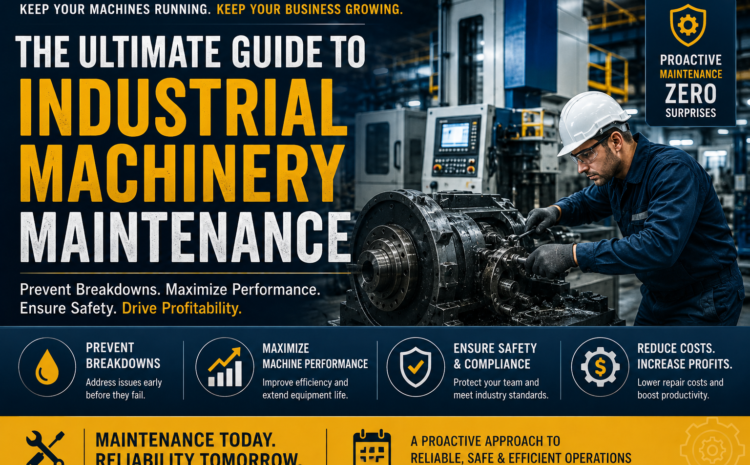
Industrial Machinery Maintenance: A Practical Guide to Preventing Downtime and Maximizing Lifespan – Copy
In any heavy manufacturing or industrial plant, the shop floor is the heartbeat of the business. Gigantic vertical turning lathes, high-precision CNC machines, and massive double-column machining centers keep production moving. But when one of these critical machines unexpectedly grinds to a halt, the silence on the factory floor is deafening—and incredibly expensive.
For plant managers and operations directors, unexpected machine failures are the ultimate nightmare. A single broken component doesn’t just halt one machine; it triggers a domino effect that leads to costly equipment downtime, missed delivery deadlines, severe production delays, and bottlenecked operations. Suddenly, your team is scrambling, repair expenses skyrocket, and your overall manufacturing efficiency plummets.
Historically, factories operated on a “run-to-failure” model—fixing things only when they broke. In 2026, with tight supply chains and high production demands, that reactive approach is a fast track to financial loss. This is why modern facilities rely heavily on structured industrial machinery maintenance, prioritizing a proactive, preventive approach. By managing your equipment health before disaster strikes, you ensure consistent machine performance, protect your workforce, and keep your production lines running smoothly.
What Is Industrial Machinery Maintenance?
Put simply, industrial machinery maintenance is the systematic practice of inspecting, servicing, preserving, and repairing factory equipment to ensure it remains in optimal working condition. It is not a single task, but an ongoing operational discipline.
Effective industrial equipment maintenance encompasses a broad spectrum of activities, including:
1. Routine Machinery Inspection: Visually and technically evaluating machines for early signs of wear, leaks, or misalignment.
2. Scheduled Servicing: Performing routine tasks like oil changes, filter replacements, and structural calibration.
3. Precision Lubrication Management: Ensuring moving parts are adequately greased to prevent friction and seizing.
4. Condition Monitoring: Tracking heat, vibration, and acoustic signatures to gauge internal component health.
5. Component Replacement: Proactively swapping out worn seals, belts, bearings, and gears before they snap.
Ultimately, the goal of industrial machinery servicing is to maximize machine performance, eliminate catastrophic failures, and ensure safe, compliant industrial operations.
The Three Main Maintenance Philosophies
To manage a plant effectively, it helps to understand the three primary layers of maintenance management:
1. Reactive Maintenance (Breakdown): Fixing equipment only after it breaks down. While it requires minimal upfront planning, it results in the highest emergency repair costs and unpredictable downtime.
2. Preventive Maintenance (Scheduled): Performing routine servicing at predetermined intervals (based on time or operating hours) to drastically reduce the likelihood of failure.
3. Predictive Maintenance (Condition-Based): Using advanced sensors and data analytics to monitor real-time machine health, repairing components exactly when they show signs of degradation but before they actually fail.
Why Preventive Maintenance Is Important in Industrial Operations
Operating a factory without a preventive industrial maintenance plan is like driving a car for 100,000 miles without changing the oil—it is a mathematical certainty that something will destroy the engine.
When a facility neglects routine care, the operational risks compound quickly. Minor, unaddressed issues like a slightly clogged hydraulic filter or a dry bearing gradually evolve into catastrophic structural failures. This results in prolonged equipment downtime, forcing your skilled operators to sit idle while you wait days for specialized replacement parts to ship. Beyond the immediate loss of production efficiency, poor maintenance introduces severe safety hazards, increasing the risk of mechanical accidents on the shop floor.
Conversely, implementing structured preventive maintenance strategies transforms your entire operational dynamic. Instead of constantly fighting fires in a reactive panic, your maintenance team works on a predictable schedule. According to manufacturing benchmarks, an effective preventive program reduces emergency repair costs by up to 30% and cuts total machinery breakdowns by more than 45%. Investing in regular upkeep directly shields your bottom line, maximizes asset utilization, and ensures a safer, highly reliable production environment.

Common Causes of Industrial Machinery Failure
Before deploying a maintenance team, you must understand what you are actually fighting against. Industrial assets operate under extreme stress, heavy loads, and harsh environmental conditions. The vast majority of mechanical breakdowns stem from a handful of predictable root causes:
1. Inadequate or Improper Lubrication: This is the single largest cause of mechanical failure. Missing a lubrication interval or using the wrong grade of oil causes immense friction, leading to overheating, component scoring, and eventual seizure.
2. Excessive Vibration: Misaligned shafts, unbalanced components, or loose mounting bolts create harmonic vibrations. Over time, this mechanical fatigue cracks structural welds and destroys precision bearings.
3. Thermal Overloading: When cooling systems fail or machines are pushed past their rated operational capacity, internal temperatures surge, causing thermal expansion, seal degradation, and warped metal components.
4. Environmental Contamination: Dust, metal shavings, moisture, and chemical residues degrade internal components. If abrasive particles bypass seals and enter gearboxes or hydraulic circuits, they cause rapid, accelerated internal wear.
5. Operational Errors: Running machines at incorrect speeds, failing to follow proper startup/shutdown sequences, or overloading a spindle strains the machinery beyond its engineering limits.
By emphasizing routine machinery inspection, your maintenance technicians can detect these early warning signs—like a slight temperature spike or a minor oil discoloration—and resolve them during a scheduled window, protecting machine reliability.
Key Preventive Maintenance Strategies for Industrial Machinery
To build a world-class industrial machinery maintenance program, you must move away from guesswork. Successful strategies rely on a combination of scheduled tasks, technical tracking, and precision adjustments.
1. Regular Machinery Inspection
The foundation of any maintenance program is the visual and physical walkthrough. Technicians should utilize a standardized maintenance checklist to evaluate equipment while idle and under load. This includes using infrared thermal cameras to detect hot spots in electrical panels, using acoustic devices to listen for bearing hiss, and checking for fluid leaks beneath gearboxes. Catching a loose bolt or a weeping seal today saves tens of thousands of rupees in emergency repairs next month.
2. Scheduled Maintenance Planning
Effective maintenance planning treats service windows with the same respect as production runs. By scheduling maintenance during planned shifts, weekends, or seasonal slowdowns, you minimize the impact on your manufacturing output. This maintenance scheduling should be dictated by a mix of manufacturer recommendations and real-world runtime metrics. For example, a CNC machine running 24/7 requires vastly different service intervals than a manual mill used twice a week.
3. Lubrication Management
Lubrication is the lifeblood of industrial machinery. However, good lubrication isn’t just about applying grease; it’s about precision. You must establish strict schedules detailing exactly which lubricant to use, how much to apply, and how often. Mixing incompatible greases can cause chemical breakdown, rendering the lubricant useless and accelerating component wear.
4. Predictive Maintenance and Condition Monitoring
For high-value assets, industries are increasingly pairing preventive care with predictive maintenance. By retrofitting older machinery with specialized sensors, teams can perform continuous condition monitoring.
Tools like vibration analysis monitors track sub-millimeter shifts in rotating shafts, while routine oil analysis measures microscopic metal particle counts within a gearbox to assess internal wear without opening the machine casing. For an excellent external resource on the technical specifications of condition monitoring tools, the ISO Maintenance Standards provide comprehensive global guidelines for machinery health analysis.
5. Replacement of Worn Components
Every mechanical part has a engineered lifespan. A proactive equipment failure prevention strategy involves replacing consumables—like drive belts, hydraulic hoses, seals, and O-rings—at regular intervals before they show visible signs of failure. Waiting for a belt to snap completely often damages adjacent pulleys and shafts, exponentially increasing the scope of your repair.
Machine Maintenance Checklist for Industrial Equipment
To help your operations team maintain consistency, use this practical, multi-tiered machine maintenance checklist for daily, weekly, and monthly workflows.
Daily Tasks
1. Check and top off all fluid reservoirs (coolant, hydraulic oils, spindle oils).
2. Inspect pressure gauges and fluid lines for leaks or sudden drops.
3. Clear chips, dust, and debris from ways, slides, and cooling vents.
4. Verify that all safety guards, emergency stops, and interlocks are functioning perfectly.
5. Listen for unusual noises or excessive vibration during startup.
Weekly Tasks
1. Clean and grease all manual lubrication points (zerk fittings, linear guides).
2. Inspect drive belts and chains for correct tension and signs of cracking.
3. Clean or replace air filters in electrical cabinets and cooling systems.
4. Inspect electrical conduits and connections for signs of fraying or overheating.
5. Review machine error logs for intermittent faults.
Monthly & Quarterly Tasks
1. Take oil samples from major gearboxes for laboratory condition monitoring.
2. Check machine leveling and structural alignment to prevent uneven component wear.
3. Tighten structural mounting bolts and electrical terminal connections.
4. Inspect and calibrate precision measuring systems, encoders, and probes.
5. Document all findings in your central maintenance management system.
Benefits of Preventive Industrial Maintenance
Transitioning your plant from a state of chaotic, reactive repairs to a smooth, preventive workflow delivers massive dividends across your entire manufacturing operation.
1. Reduced Equipment Downtime
When maintenance is planned, downtime is controlled. Servicing a machine for two hours on a Saturday morning prevents a catastrophic failure that could shut down your entire assembly line for five days straight in the middle of a high-priority production run, dramatically stabilizing your operational efficiency.
2. Improved Machine Reliability
Regularly calibrated and well-lubricated machinery operates with higher precision and repeatability. This consistency drastically reduces your scrap rates, eliminates product defects, and ensures that your final output meets strict engineering tolerances every single run.
3. Lower Repair Costs
Catching wear early means replacing a $50 bearing instead of a $5,000 spindle assembly. Furthermore, avoiding emergency breakdowns means you don’t have to pay premium prices for expedited shipping on spare parts or hire expensive, external master technicians at short notice.
4. Increased Equipment Lifespan
Industrial machinery represents a massive capital expenditure. By keeping internal components clean, aligned, and properly lubricated, you significantly extend the productive equipment lifespan of your assets, maximizing the long-term return on your capital investments.
5. Better Manufacturing Efficiency
When your production team knows the machinery is reliable, workflows run predictably. Schedules are met, operators work without interruption, and your overall production efficiency rises, making your entire enterprise more competitive in the market.
Industrial Automation and Smart Maintenance Systems
As we move deeper into the era of Smart Manufacturing, industrial automation is completely reshaping how plants approach reliability. Modern production lines don’t rely solely on a technician’s clipboard; they use intelligent, interconnected ecosystems.
Through the deployment of IoT (Internet of Things) smart sensors, machines now actively broadcast their own health metrics. These sensors feed real-time temperature, electrical draw, and vibrational data into centralized computerized maintenance management systems (CMMS). Using predictive analytics, the software can automatically flag anomalies, order replacement parts from inventory, and log a service ticket into the maintenance schedule before human operators even realize a component is degrading. Adopting these Industry 4.0 condition monitoring practices bridges the gap between raw physical machinery and digital efficiency.
Common Maintenance Mistakes Industries Should Avoid
Even well-intentioned maintenance programs fail if they commit these common operational errors:
1. Treating Checklists as “Tick-Box” Exercises: Technicians rushing through inspections, checking boxes without thoroughly investigating the machine’s actual state.
2. Delayed Inspections to Hit Production Quotas: Pushing a machine through an extra shift when it is already overdue for service. This temporary gain always results in a long-term breakdown.
3. Poor Maintenance Documentation: Failing to log what was fixed, when it was fixed, and what parts were used. Without clean data, you cannot spot recurring failure trends.
4. Improper Lubrication Habits: Assuming all greases are the same, over-greasing (which destroys bearing seals), or neglecting automated lubrication system reservoirs.
5. Neglecting Ancillary Equipment: Focusing entirely on the main CNC machine while ignoring the air compressors, chillers, and chip conveyors that the main machine relies upon to function.
Best Practices for Effective Industrial Machinery Maintenance
To establish a world-class, long-term culture of reliability on your shop floor, implement these proven industrial maintenance best practices:
1. Empower Your Operators (Autonomous Maintenance): Train your machine operators to handle basic daily care—like cleaning, visual checks, and fluid top-offs. Because they spend eight hours a day with the machine, they are always the first to notice subtle changes in sound or performance.
2. Invest in Continuous Training: Industrial equipment evolves rapidly. Ensure your core maintenance team receives regular training on specialized diagnostic tools, laser alignment methods, and smart automation systems.
3. Maintain a Strategic Spare Parts Inventory: Identify your “critical-path” components—the high-wear parts that would instantly paralyze production if they broke. Keep these items stocked in-house to reduce lead times from weeks to minutes.
4. Analyze Historical Maintenance Data: Regularly review your maintenance logs to calculate metrics like Mean Time Between Failures (MTBF). If a specific machine keeps breaking down every 300 hours, it indicates an underlying structural or operational issue that needs a redesign, not just another quick fix.
Final Thoughts
At the end of the day, successful industrial machinery maintenance is about moving from a culture of panic to a culture of predictability. While implementing a structured preventive and predictive program requires an investment of time, training, and organization, the return on investment is undeniable.
Protecting your factory assets means protecting your delivery promises, your workforce, and your profitability. If you are looking to showcase your industrial capabilities or streamline your digital operations, partner with experts at engi-mach who understand the technical landscape.